

Posts by admin
AI Cooling Is Becoming a Power-and-Thermal System — Commissioning Has to Catch Up

AI cooling is no longer simply a mechanical system serving an IT load. Power, cooling, controls, and compute are becoming parts of the same operating system. That changes what commissioning needs to prove. For most of my career, facility power and mechanical cooling were treated as separate disciplines. Electrical engineers worried about getting power to…
Read MoreThe Hidden Control-Layer Problem: How PID Loop Performance Can Affect Data Center PUE

KMC² Engineering Case Analysis The Hidden Control-Layer Problem: How PID Loop Performance Can Affect Data Center PUE This six-chiller hyperscale analysis examines how PID tuning, staging logic and synchronized trend data can affect data center PUE—and why system-level verification matters more than any single setpoint. Hyperscale cooling PID loop analysis PUE attribution CRAC / CRAH…
Read MoreBeyond the Cold Plate: The Missing Thermal Control Plane in AI Data Centers
Engineering Research Analysis Thermal Control Plane for AI Data Center Cooling Beyond the Cold Plate examines why GPU and SoC cooling must be evaluated by thermal response, observability, fluid integrity, and recovery—not only by steady-state heat-removal capacity. By Martin P. King · Founder, King Mission-Critical Consulting Public-information and independence note This independent engineering analysis is…
Read MoreMRI Cooling System Failure: The Chiller Never Alarmed
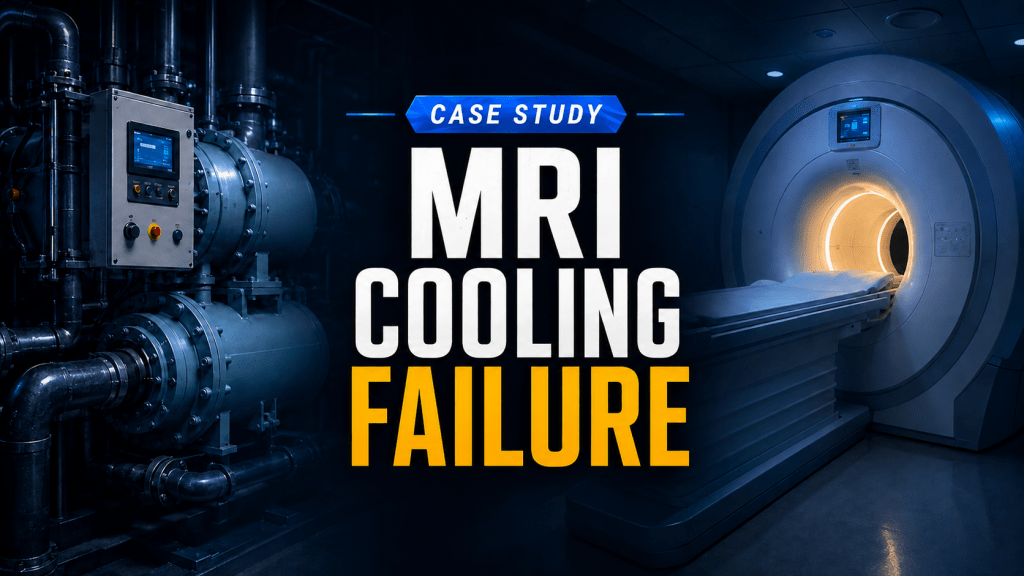
Case Study · Medical Imaging MRI Cooling System Failure: The Chiller Never Alarmed A hidden hydraulic restriction reduced cooling-water flow to a high-use MRI—even while the process chiller stayed online, maintained leaving-water temperature, and showed no refrigeration fault. The chiller appeared normal. Cooling delivery at the MRI was not. Visible Warning Intermittent MRI water-flow alarms…
Read MoreWhy Data Center Equipment Failures Keep Repeating
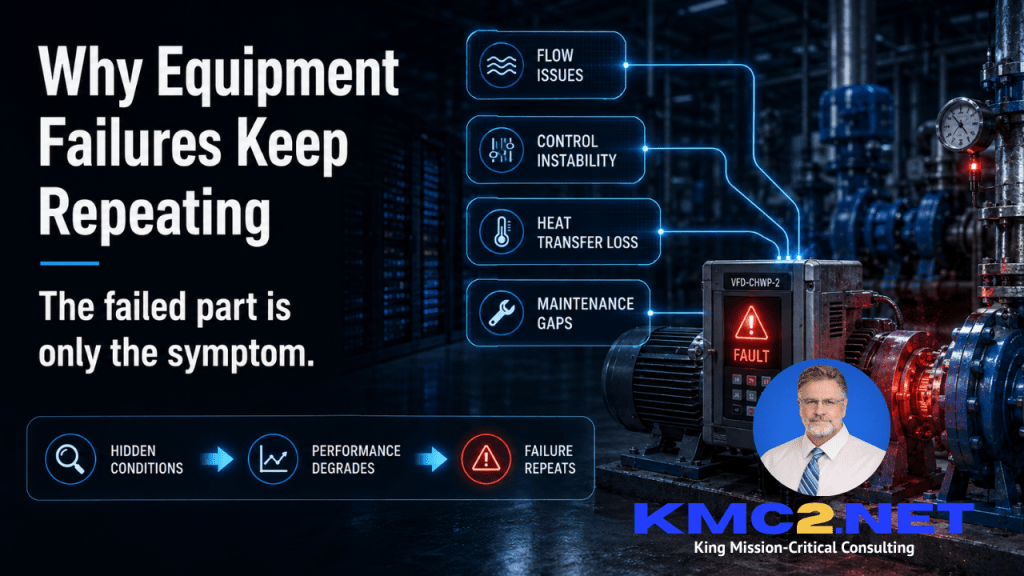
When data center equipment failures keep repeating, replacing the failed component may restore operation—but it does not necessarily restore reliability. The failed part may only be the final link in a much longer chain of cooling, control, maintenance, and operating conditions. Get the equipment back online. The failed component is replaced. Alarms clear. Temperatures stabilize.…
Read MoreThe Failure Wasn’t Sudden: The Cooling Warning Signs Everyone Missed
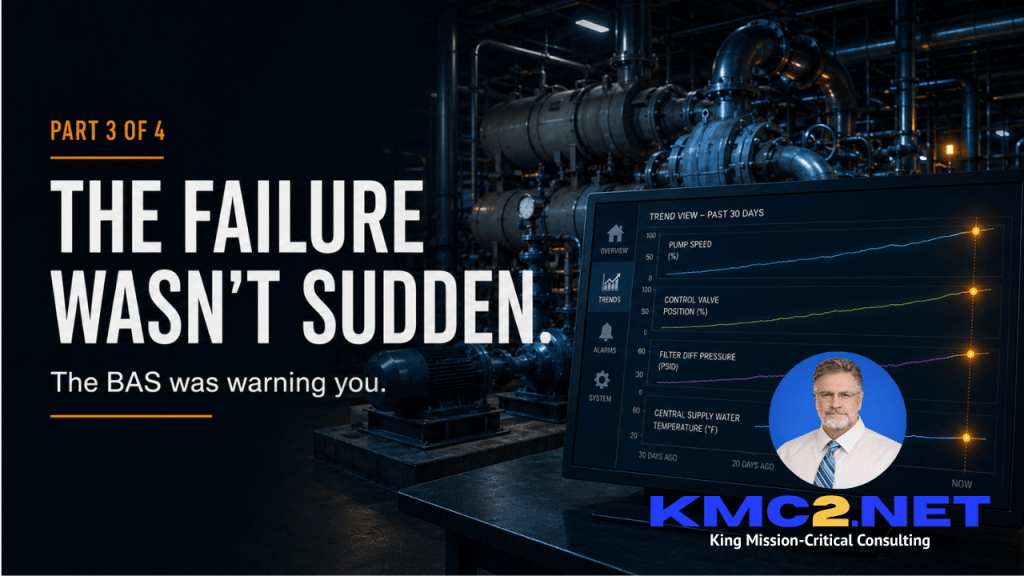
Part 3 of 4 — The evidence was there before the downtime Mission-critical cooling systems rarely fail without warning. The evidence often appears weeks earlier in pump speed, valve position, differential pressure, recovery time, and operator workarounds—if anyone knows how to connect it. Forty-three days before the cooling failure, nothing was broken. The following scene…
Read MoreThe Systems That Pass Commissioning but Fail Under Real Operating Conditions
Part 2 of 4 —Accepted is not the same as proven. The commissioning report looked clean. Pumps started. Valves stroked. Alarms came in. The chiller hit leaving-water temperature. The standby unit rotated on command. The checklist was signed, filed, and handed to the owner. Three months later, during the first real heat event, the same…
Read MoreMission-Critical Commissioning: Why “Passed” Does Not Mean Proven
Part 1 of 4 — The Failures That Begin After Sign-Off Why a system can pass startup and functional testing, then fail under the operating conditions that actually matter. A mission-critical compressed dry air compressor failed every four to six weeks for nearly two years. Not because the operations team ignored it. Not because maintenance…
Read MoreYour Cooling System Isn’t Failing. It’s Costing You Money.
The connection between cooling loop drift and AI training run overruns that almost no one is drawing. The Problem Nobody Reports The GPU didn’t fail. Nobody called an emergency. The commissioning report from eight months ago still looks clean. But the AI team’s training runs — the weeks-long computational processes of building and refining AI models —…
Read MoreAI Workloads Are Compressing Cooling Failure Timelines — And Most Facilities Aren’t Ready
The Warning Signs Are Still There. The Window to Act on Them Isn’t. Cooling systems have always given warnings before they fail. That has not changed. What has changed is how much time you have between the first warning and the point where recovery becomes impossible. Three years ago, a developing thermal issue in a…
Read More