
Why Data Center Equipment Failures Keep Repeating
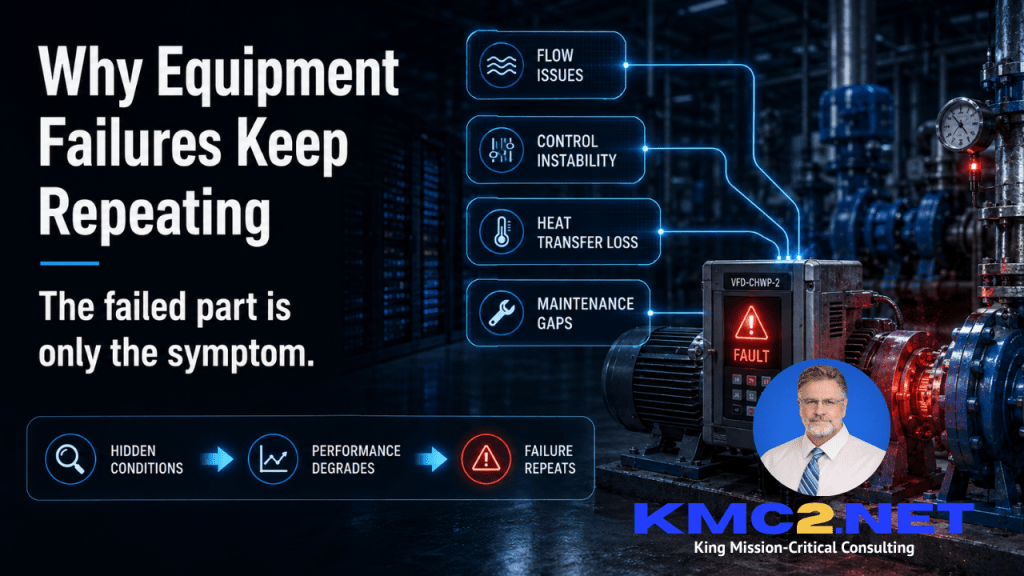
When data center equipment failures keep repeating, replacing the failed component may restore operation—but it does not necessarily restore reliability. The failed part may only be the final link in a much longer chain of cooling, control, maintenance, and operating conditions.
Get the equipment back online.
The failed component is replaced. Alarms clear. Temperatures stabilize. The maintenance ticket is closed, and the facility returns to normal operation.
At least, that is what everyone hopes.
Then the same piece of equipment fails again.
Sometimes it is the exact same component. Sometimes it is another component performing the same function. In other cases, the second failure appears unrelated—but is actually being caused by the same underlying operating condition.
At that point, the facility no longer has an equipment problem.
It has a reliability problem.
That distinction matters because equipment problems are usually visible. Reliability problems often remain hidden inside operating sequences, control logic, water flow, system pressure, maintenance practices, sensor accuracy, changing loads, or the way multiple systems interact.
The component that failed may only be the final link in a much longer chain.
Why Data Center Equipment Failures Are Often Symptoms
Many data center equipment failures are not isolated equipment problems. They are visible symptoms of conditions developing elsewhere in the system.
After more than four decades working with process cooling, HVAC systems, controls, manufacturing equipment, medical imaging systems, semiconductor facilities, and other mission-critical environments, I have learned to be cautious about calling a failed component the root cause.
A compressor may fail because of inadequate refrigerant management, unstable water temperature, excessive cycling, poor heat transfer, or operation outside the conditions for which it was selected.
A pump VFD may fail because of heat, electrical conditions, repeated starts, improper programming, unstable control commands, or a mechanical system that continually forces it to operate at the edge of its range.
A valve may appear defective when the real problem is insufficient differential pressure, an upstream restriction, unstable pump control, poor sensor placement, or conflicting sequences.
A cooling unit may repeatedly alarm because of restricted airflow, incorrect setpoints, fouled heat exchangers, changing rack density, inadequate water flow, or another unit that is not carrying its intended share of the load.
Replacing any of these components may be necessary.
But replacement alone does not answer the most important question:
What conditions allowed the failure to occur?
Until that question is answered, the facility may simply be resetting the clock for the next failure.
Why Traditional Root-Cause Reviews Often Fall Short
Investigations into data center equipment failures often stop once technicians identify how the component failed, rather than determining why the system allowed it to fail.
Most data center operators understand the importance of root-cause analysis. The problem is that the review frequently stops too early.
A typical investigation may conclude that:
- A bearing failed.
- A motor overheated.
- A drive faulted.
- A sensor drifted.
- A control board lost communication.
- A compressor experienced an internal electrical failure.
Those findings may be technically accurate, but they describe how the component stopped working. They do not necessarily explain why the system created or failed to detect the conditions leading to the failure.
A complete investigation must go beyond the failed part and evaluate the surrounding reliability chain.
That chain may include:
- Equipment selection and original design assumptions
- Current facility and IT loads
- Water and airflow distribution
- Control sequences and PID behavior
- Sensor location, calibration, and failure response
- Equipment staging and rotation
- Alarm priorities and time delays
- Preventive-maintenance practices
- Water chemistry and heat-exchanger condition
- Bypass valves and unintended flow paths
- Changes made since commissioning
- Operator procedures and response expectations
- The interaction between redundant equipment
This broader view is increasingly important because modern cooling systems rely on coordinated controls, communications, variable-speed equipment, sensors, and automated staging. ASHRAE has observed that poor control-system design and implementation can be responsible for major cooling failures even when the mechanical equipment itself is functional.
The more interconnected the cooling system becomes, the less likely it is that reliability can be understood by examining one component at a time.
Redundancy Does Not Automatically Create Reliability
Repeated data center equipment failures can occur even in redundant systems when both the primary and standby equipment are exposed to the same operating condition.
Data center owners invest heavily in redundant chillers, pumps, cooling towers, CRAHs, CRACs, fans, controls, power sources, and distribution paths.
That investment is necessary, but installed redundancy is not the same as proven redundancy.
A standby pump provides little protection if:
- The automatic changeover sequence does not work.
- A closed valve prevents the standby pump from establishing flow.
- Both pumps depend on the same sensor or controller.
- The standby pump has not operated under realistic load.
- The lead and standby units do not rotate properly.
- An alarm tells the operator that the backup started when it did not establish the required flow.
- Both pieces of equipment are exposed to the same damaging operating condition.
Similarly, an N+1 chiller plant may still have a single point of failure hidden in its controls, common piping, power distribution, communications, or operating sequence.
Redundancy exists on a drawing.
Reliability must be demonstrated under actual operating conditions.
This is one reason commissioning results must be treated as the beginning of the reliability process—not the end.
A system can pass its original functional test and still become vulnerable later because of programming changes, load growth, maintenance activity, failed sensors, overridden commands, or equipment that no longer performs as it did when commissioned.
The question is not merely whether the backup equipment exists.
The question is whether the entire system can recognize a failure, respond correctly, maintain the required conditions, notify the right people, and recover without creating a second problem.
The Dangerous Phrase: “It’s Running Now”
One of the most misleading indicators in a mission-critical mechanical system is that the equipment is currently running.
Running does not necessarily mean healthy.
A system may be operating while:
- A heat exchanger is gradually fouling.
- A pump is approaching the limit of its available head.
- A control loop is oscillating.
- Two sensors are reporting different conditions.
- A normally closed bypass valve is leaking.
- A standby unit is unavailable.
- A filter is accumulating debris.
- A compressor is short-cycling.
- A valve is nearly wide open under normal load.
- A cooling unit is carrying more load than the others.
- The BMS is recording data that no one is reviewing.
- An alarm has been suppressed because it became a nuisance.
- Operators are manually compensating for an unresolved automatic-control problem.
None of these conditions necessarily causes an immediate outage.
That is precisely what makes them dangerous.
They allow the facility to continue operating while resilience is quietly disappearing.
When a second event occurs—high outdoor temperature, an IT load increase, a utility disturbance, a maintenance shutdown, or the loss of another component—the remaining margin may be much smaller than anyone realizes.
The resulting failure may appear sudden.
The conditions that produced it may have existed for weeks, months, or even years.
Data Is Not the Same as Insight
Many facilities collect enormous amounts of operational data.
Temperatures, pressures, valve positions, fan speeds, pump speeds, alarms, equipment status, electrical demand, flow rates, and setpoints may all be stored in a BMS, DCIM platform, chiller controller, PLC, or equipment dashboard.
But storing data does not automatically improve reliability.
For data to become useful, it must answer operational questions such as:
- Does this equipment operate differently from its identical counterpart?
- What changed before the last three failures?
- Is a valve responding properly to its command?
- Does the measured temperature make sense compared with nearby sensors?
- Is the system stable, or constantly hunting around its setpoint?
- Does the standby equipment actually start and carry the load?
- Are pumps operating within an efficient and reliable range?
- Is cooling capacity being lost gradually?
- Are alarm patterns telling us something before equipment trips?
- Did a maintenance or programming change alter system behavior?
A trend graph is only valuable when someone understands what should be happening and compares it with what is actually happening.
Even then, the available data may not tell the complete story.
A BMS can show that a pump is commanded on. It may not prove that the pump is establishing the correct flow.
It can show a valve at 100% command. It may not prove that the valve is fully open.
It can show a stable supply-water temperature while individual branches receive inadequate flow.
It can show that a standby chiller started without demonstrating that the plant maintained the required conditions during the transition.
This is why a meaningful reliability review combines data with field observation, system knowledge, operating history, maintenance records, and conversations with the people who work with the equipment every day.
Repeated Failures Usually Cross Departmental Boundaries
Another reason failures repeat is that no single organization owns the entire reliability chain.
The mechanical contractor may focus on the failed equipment.
The controls contractor may focus on whether the programmed sequence operates as written.
The equipment manufacturer may evaluate whether its product operated within its published requirements.
The commissioning provider may refer to the conditions that existed when testing was performed.
The facility team may be focused on restoring service and managing current priorities.
The IT organization may only see the resulting temperature alarms or service disruption.
Each party may do its job correctly while the larger system-level problem remains unresolved.
The failure may live in the space between those responsibilities.
For example, a chiller manufacturer may confirm that the chiller is operating properly. The pump vendor may confirm that the pump is operating. The controls contractor may confirm that the system is following the programmed sequence.
Yet the plant may still be inefficient, unstable, or vulnerable because the sequence itself does not match the current load, the flow distribution has changed, or the system was never tested under the combination of conditions that now exists.
Someone must step back and examine the complete system.
Human Error Is Often a System Problem Too
When an operator misses a step or responds incorrectly to an alarm, it is tempting to label the event as human error and move on.
That can be another incomplete root-cause conclusion.
Uptime Institute reported in its 2025 outage analysis that nearly 40% of surveyed organizations had experienced a major outage involving human error during the preceding three years. Of those events, 85% involved either procedures not being followed or weaknesses in the procedures themselves.
That distinction is important.
An operator may make the wrong decision because:
- The alarm message is unclear.
- Multiple alarms arrive without useful prioritization.
- The procedure does not match the current system.
- The required information is spread across several platforms.
- The expected automatic response did not occur.
- Training covered normal operation but not degraded operation.
- The operator cannot easily determine which sensor is correct.
- The control sequence is so complex that the system response is difficult to predict.
- Previous nuisance alarms conditioned the team to ignore a legitimate warning.
In those cases, blaming the individual does not reduce future risk.
The better question is:
What information, procedure, training, interface, or system response would have made the correct action easier and more likely?
That is a reliability question—not simply a personnel question.
Why the Risk Is Increasing
Data center infrastructure is being asked to support larger and more dynamic loads. AI deployments are accelerating that shift, while power and cooling constraints are becoming more visible.
The International Energy Agency reported that global data center electricity consumption increased by approximately 17% during 2025. In the United States, rapidly increasing data center loads accounted for roughly half of the country’s electricity-demand growth that year.
Facilities are therefore being asked to do more with systems that may have been designed, commissioned, or programmed for a different operating profile.
That can expose weaknesses that remained hidden under lighter or more predictable loads.
A valve that normally operated at 60% may now remain nearly fully open.
A pump that once had substantial reserve may now be operating close to its limit.
A standby chiller that rarely operated may suddenly become essential during peak conditions.
Cooling-unit imbalances that were once manageable may become critical as rack densities increase.
A control sequence developed for stable loads may respond poorly to rapid changes.
The problem is not always that the equipment is old or inadequate.
The problem may be that the operating environment has changed while the reliability strategy has not.
How to Investigate Data Center Equipment Failures
A stronger investigation into data center equipment failures begins with the failed component but expands quickly to the surrounding system.
1. Reconstruct the event
Establish what happened before, during, and after the failure.
Review alarms, trends, operator actions, weather, facility load, equipment status, maintenance activity, and control commands.
Do not rely solely on the final alarm. The most useful evidence may have occurred hours or days earlier.
2. Compare identical equipment
If two or more pumps, chillers, cooling units, or fans perform the same function, compare their operating behavior.
Differences in temperatures, pressures, run times, speed, cycling frequency, valve position, or energy consumption can reveal developing problems.
3. Examine the surrounding system
Determine what the failed equipment was being asked to do.
Was the system maintaining adequate flow? Was heat transfer impaired? Were setpoints stable? Was the equipment operating within its intended range? Were other components compensating for a hidden deficiency?
4. Review controls and failure responses
Confirm how the system was designed to respond—and then determine how it actually responded.
Verify sensor logic, alarms, time delays, lead-lag rotation, permissives, safeties, fail positions, communications, and automatic changeover.
5. Look for common-cause exposure
Redundant components may share the condition that caused the first failure.
They may share power, cooling water, controls, sensors, network communications, piping, maintenance practices, environmental conditions, or programming.
Replacing the first failed component without addressing the shared exposure leaves the backup vulnerable.
6. Verify corrective actions
A recommendation is not complete until the result is verified.
Did the control change stabilize the system?
Did the standby equipment carry the real load?
Did the flow correction improve all branches?
Did the alarm reach the right person?
Did the repeated-failure pattern disappear?
Reliability improvements must be demonstrated—not assumed.
The KMC² Approach: Follow the Entire Reliability Chain
KMC² was built around a practical idea:
Mission-critical failures are rarely isolated events. They are usually the result of conditions developing across an interconnected system.
Our role is not to replace the facility team, service contractor, controls provider, commissioning agent, or equipment manufacturer.
Our role is to connect the information those groups already possess and examine the system from an independent, operations-focused perspective.
KMC² helps operators examine data center equipment failures from an independent, system-level perspective rather than treating each failed component as an isolated event.
That means looking beyond the failed part and evaluating:
- What the system was originally designed to do
- How it is currently operating
- What has changed
- Where resilience has been reduced
- What the available data actually proves
- What remains untested
- Which conditions could produce the next failure
- Which corrective actions will provide the greatest reduction in risk
Sometimes the answer is a major capital improvement.
Often, it is not.
The highest-value findings may involve a control-sequence correction, a sensor problem, a flow restriction, a failed changeover function, an overlooked maintenance condition, an unstable setpoint, poor equipment rotation, or a mismatch between present operations and original design assumptions.
The objective is not to generate a longer list of deficiencies.
It is to identify the small number of conditions most likely to affect uptime, equipment life, energy use, and operational confidence.
Stop Resetting the Failure Clock
When data center equipment failures are addressed only by replacing the damaged part, the facility may restore operation without correcting the condition that caused the failure.
When a failed component is replaced, the facility has restored operation.
When the conditions behind the failure are identified and corrected, the facility has improved reliability.
Those are not the same outcome.
Data center operators should be skeptical of any repeated failure that is explained only by the name of the component that broke.
Bearings fail.
Motors overheat.
Drives trip.
Sensors drift.
Compressors burn out.
But those statements are the beginning of the investigation—not the end.
The more important question is what the surrounding system did, or failed to do, that allowed the component to reach that point.
That is where hidden operational risk is usually found.
And that is where meaningful reliability improvement begins.
Is a Failure Pattern Developing in Your Facility?
If data center equipment failures keep returning, the next step should not be another isolated repair. KMC² helps data center operators connect equipment history, operating data, control behavior, maintenance conditions, and system performance to identify why the problem continues.
The process begins with a focused review of the equipment history, operating data, control behavior, and conditions surrounding the failure.
The goal is straightforward:
Identify why the problem keeps returning—and determine what must change to prevent the next event.
Visit KMC2.net to start a conversation..
Martin P. King works with facility and engineering teams to uncover hidden reliability risks in mission-critical cooling infrastructure.