
AI Cooling Is Becoming a Power-and-Thermal System — Commissioning Has to Catch Up
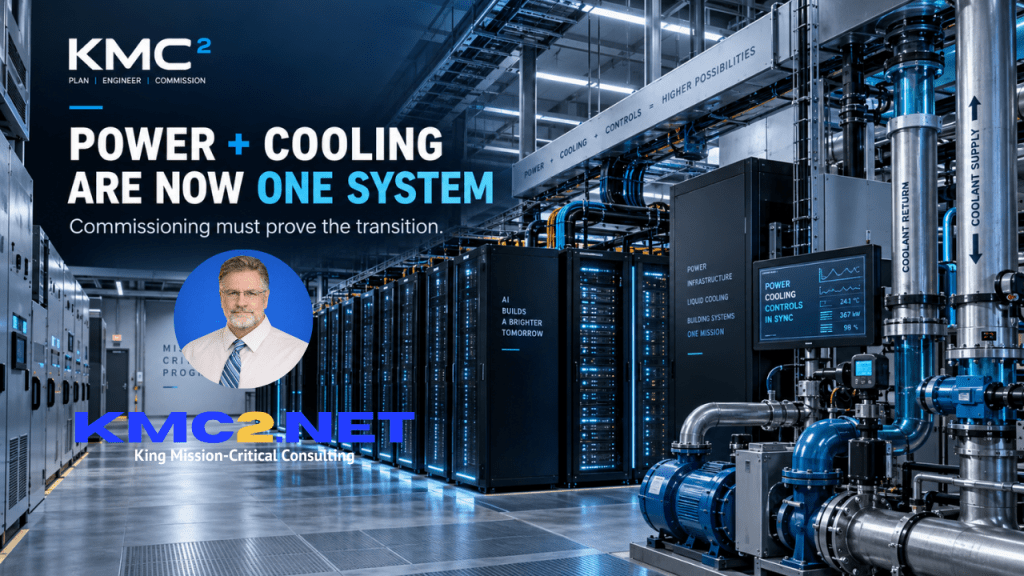
AI cooling is no longer simply a mechanical system serving an IT load.
Power, cooling, controls, and compute are becoming parts of the same operating system.
That changes what commissioning needs to prove.
For most of my career, facility power and mechanical cooling were treated as separate disciplines. Electrical engineers worried about getting power to the load. Mechanical engineers worried about getting heat away from it. Controls connected the pieces.
That separation was never as clean as the drawings made it look, but it worked reasonably well when equipment densities were lower and thermal response times were more forgiving.
AI infrastructure is changing that.
The equipment can all work individually — and the facility can still fail during the transition.
Why AI Cooling Is Becoming a Power-and-Thermal System
Look at where the industry is heading.
NVIDIA’s current
DSX facilities reference design
treats site power, cooling, controls, and compute as coordinated infrastructure. The reference architecture includes liquid-cooled racks, coolant distribution units, facility-water systems, heat rejection, battery energy storage, and backup generation as interacting parts of the same AI factory.
Cabinet heat loads in the reference design extend into the hundreds of kilowatts. Cooling-water temperatures are moving higher. Liquid cooling is moving closer to the silicon. At the same time, the electrical architecture supporting those loads is changing just as quickly.
These are not isolated technology changes.
They are changing the behavior of the facility.
And behavior is where reliability problems usually show up.
THE OLD QUESTION
Does each component work?
THE AI INFRASTRUCTURE QUESTION
Does the entire system recover before the load notices?
A System Can Pass Every Individual Test and Still Fail the Transition
Consider a utility disturbance at a liquid-cooled AI facility.
The electrical system recognizes the event.
UPS-supported equipment continues operating where required.
Backup generation begins its sequence.
Some cooling equipment may momentarily lose power.
Pumps restart.
Control systems recover communications.
Valves return to position.
Coolant distribution units continue trying to protect the racks.
Meanwhile, the compute load has its own behavior.
Nothing in that sequence has to be completely broken for the facility to get into trouble.
The generator can start correctly. The pump can start correctly. The valve can stroke correctly. The CDU can be operating exactly as designed.
And the thermal condition at the rack can still move outside the intended operating window because the timing between those events was never proven.
That is the commissioning gap I believe deserves more attention.
Component testing tells us whether equipment works.
Mission-critical commissioning also has to prove whether the system recovers.
Thermal Mass Is Part of the Failure Sequence
One detail in current AI-factory reference architectures is particularly interesting from a reliability standpoint.
During certain electrical disturbances, portions of a cooling plant may not have uninterrupted power. The system can depend partly on thermal mass in the fluid, piping, and heat exchangers while backup power becomes available and mechanical equipment restarts.
There is nothing inherently wrong with that strategy.
Thermal storage in water and piping has always existed.
But once thermal mass becomes part of the ride-through strategy, time becomes an engineering variable.
- How many seconds of usable thermal margin exist?
- How quickly does flow decay?
- How quickly does the load respond?
- How long does the electrical transition actually take?
- How quickly do pumps reestablish stable flow?
- What happens if a valve, sensor, or communication path recovers more slowly than expected?
Those questions do not belong exclusively to either the electrical or mechanical team.
They belong to the operating system.
AI Loads Are Making These Interactions More Important
Modern AI infrastructure is also becoming more dynamic.
Compute power is no longer simply a fixed load that the mechanical plant follows slowly in the background. Software can influence power allocation across GPUs and racks. Battery systems can interact with changing electrical demand. Cooling-water temperatures can move higher to improve facility efficiency.
That creates tremendous opportunity.
It also creates new interactions.
Current AI-factory architectures increasingly exchange power, thermal, and operating information across infrastructure that historically lived in separate engineering silos.
Trane and Eaton have also published a
coordinated AI data-center power-and-cooling reference design
rather than treating electrical and thermal infrastructure as isolated systems.
That tells me something important.
The industry itself is acknowledging that the old silos are becoming less useful.
Commissioning cannot remain trapped inside them.
Why Traditional Commissioning Can Miss the Real Risk
Most commissioning programs are organized around equipment and scope.
✓ Test the chiller.
✓ Test the pumps.
✓ Test the generator.
✓ Test the switchgear.
✓ Test the CDU.
✓ Stroke the valves.
✓ Verify the alarms.
✓ Confirm the sequence.
All of that matters.
But individual test scripts can still miss the question the operator actually cares about:
What happens to the load when several systems change state at the same time?
That is where a clean commissioning report can create false confidence.
A standby pump may start correctly during its functional test.
A generator may transfer within specification during its test.
A cooling-control sequence may work correctly during its test.
But if the real failure requires all three to happen in the right order, under real load, the individual results do not prove the combined outcome.
SPEC MET ≠ UPTIME
What Better Mission-Critical Commissioning Needs to Prove
I am not suggesting that every possible failure combination needs to be tested.
That is neither practical nor necessary.
But facilities supporting high-density AI compute should identify the transitions where power and thermal behavior are most tightly coupled.
Then prove the behavior that matters.
1. Pump Loss at High Load
What happens to flow, differential pressure, and rack inlet temperature before standby flow stabilizes?
2. Utility Disturbance
Does the cooling system recover within the actual available thermal ride-through time?
3. Controls Recovery
What happens if communications recover faster—or slower—than the mechanical equipment?
4. Valve Transition
Does commanded valve position actually create the hydraulic condition the control sequence expects?
5. Operation Near the Real Thermal Limit
Does the recovery sequence still work when the facility is operating closer to its actual load than it was during initial acceptance testing?
The objective is not to create more paperwork.
It is to expose the failure paths that exist between the equipment.
The Definition of AI Cooling Commissioning Has to Expand
AI cooling is no longer simply a mechanical utility serving an IT load.
Power availability affects cooling behavior.
Cooling availability affects compute performance.
Controls determine how both systems respond.
Software is increasingly influencing the operating envelope.
And as rack density rises, the time available to recover from an abnormal condition can become increasingly important.
That makes the facility a power-and-thermal system.
The engineering disciplines still matter.
The equipment still matters.
The specifications still matter.
But reliability lives in the interactions.
The next generation of mission-critical commissioning needs to prove more than whether every component performs its assigned function.
It needs to prove that the entire system can recognize a disturbance, transition correctly, maintain enough thermal margin, and return to stable operation before the load notices.
The real test of redundancy is not what is installed.
It is what the facility actually does when something goes wrong.
Related KMC² Field Notes
If this issue sounds familiar, these related KMC² resources go deeper into the operating side of the problem:
-
The Systems That Pass Commissioning but Fail Under Real Operating Conditions
-
AI Data Center Cooling Field Notes
-
KMC² Cooling Reliability Consulting Services
Bring the Cooling Problem That Isn’t Adding Up
KMC² provides independent, vendor-neutral cooling reliability, commissioning, and troubleshooting support for mission-critical facilities.
If the explanations do not agree, a failure keeps returning, or the system passed its tests but still feels fragile, start with the behavior your team is seeing.