
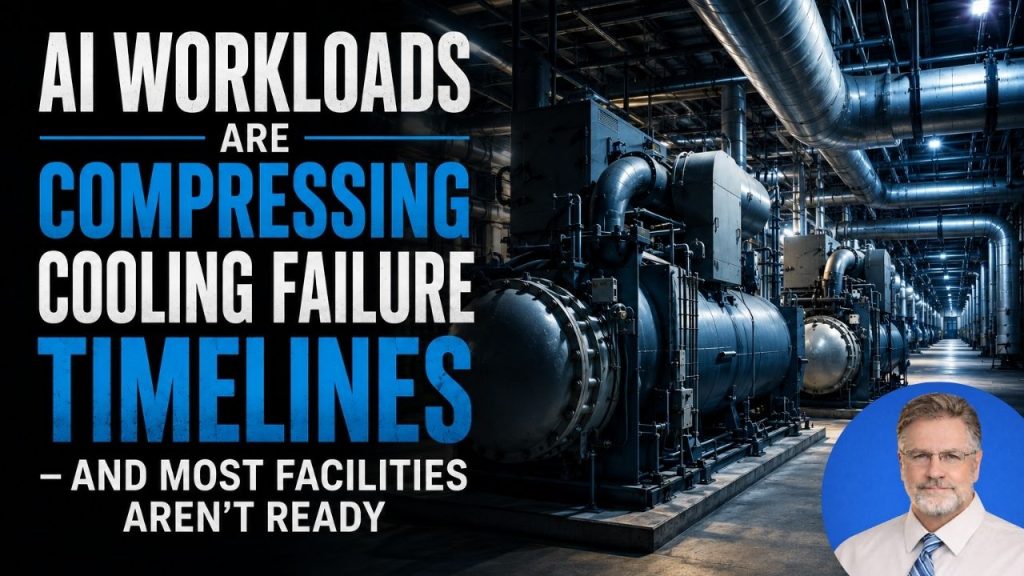
AI Workloads Are Compressing Cooling Failure Timelines — And Most Facilities Aren’t Ready
The Warning Signs Are Still There. The Window to Act on Them Isn’t.
Cooling systems have always given warnings before they fail. That has not changed. What has changed is how much time you have between the first warning and the point where recovery becomes impossible.
Three years ago, a developing thermal issue in a chiller plant might announce itself over several weeks. Gradual temperature rise, a pump running slightly outside its curve, a control loop hunting a little more than it used to. Experienced operators who paid attention could catch it. Maintenance could schedule a shutdown window and fix it before anyone upstream ever noticed.
That window has collapsed.
In facilities running AI and high-performance compute workloads, rack densities have climbed from a legacy average around 20 kilowatts to 100 kilowatts and beyond. Some GPU clusters push beyond 150 kilowatts per rack. At those densities, a cooling system running close to its operational limits does not drift toward failure the way it used to. It compresses toward failure. A thermal issue that might have unfolded over two weeks in a conventional data center can now escalate in hours.
The operations teams in many of these facilities are still watching the same signals, on the same schedules, that worked three years ago. They are not wrong to use those systems. They are wrong to assume those systems are sufficient.
The Hidden Problem: Operational Margins Have Narrowed Without Operational Practices Catching Up
Mission-critical cooling infrastructure was engineered for a different era of compute. Chilled water plants, cooling towers, pump systems, and heat rejection equipment were designed around predictable, manageable thermal loads. The controls were tuned accordingly. The maintenance intervals were set accordingly.
Then AI workloads arrived. Facilities that once ran racks at 15–20 kilowatts are now hosting GPU clusters at 80, 100, or 120 kilowatts in the same floor space. The cooling infrastructure was not redesigned to match. In many cases, it was extended — additional capacity bolted on, supplemental liquid cooling added, controls adjusted — but the underlying system architecture and its operational assumptions were left in place.
The result is a cooling plant operating on margins that were acceptable when load was predictable and moderate. Under AI workloads, those margins disappear faster than anyone planned for.
A pump that was appropriately sized for the original design is now running continuously at or near its operational ceiling. A control setpoint that was stable under conventional load becomes unstable when a GPU cluster spikes from 10 percent utilization to 100 percent in seconds. A chiller that met specification when it was commissioned is being asked to do something it was never tested to do.
Spec met does not equal uptime. It never did. Under AI workloads, that gap between specification and operational reality has become dangerous.
What This Looks Like at a Real Facility
Consider a research facility that transitioned a portion of its compute infrastructure to support large-scale AI training runs. The facility had a well-maintained chiller plant — regularly serviced, performance verified during annual commissioning reviews, no outstanding reliability issues on record.
When the AI cluster went online and began sustained training runs, the facility discovered something the commissioning report had never needed to address: their primary chiller’s capacity buffer, which looked generous on paper, was insufficient when the AI load ramped simultaneously with warm ambient conditions. The facility was in the middle of summer. The cooling tower could not reject heat fast enough under the combination of peak AI load and outdoor temperatures.
The chiller reached its high-pressure limit. It tripped. The backup chiller started. So far, the redundancy plan was working.
What nobody had planned for was that the same ambient conditions causing the primary to trip were also pushing the backup toward its limits. The backup ran for four hours before it too began alarming. By the time the situation was stabilized, the AI training run had been interrupted twice, the facility had accumulated several hours of degraded cooling capacity, and the operations team had spent the better part of a day managing a situation that — in retrospect — had been building slowly for weeks in a form they simply were not watching for.
The system met specification. The failure happened anyway.
Why Experienced Teams Still Get Caught by This
This is not a story about negligence. The engineers and operations staff at facilities like this one are competent professionals. They maintain their equipment. They respond to alarms. They follow their procedures.
The problem is that the procedures, the alarm thresholds, and the maintenance intervals were built for a different threat model. Periodic manual inspections and threshold-based alarms were sufficient when thermal loads were stable and predictable. They are not sufficient when loads spike from idle to maximum in seconds and sustain that output continuously for days.
There is also an experience gap that the industry has been reluctant to discuss directly. A significant percentage of the engineers who developed deep intuition about mission-critical chiller plants — who could walk into a mechanical room and sense that something was wrong before the instruments confirmed it — have retired or are approaching retirement. The teams replacing them are skilled, but they are inheriting systems they did not grow up with, in operational conditions that did not exist when those systems were designed.
That combination — compressed failure timelines, legacy operational practices, and reduced institutional knowledge — creates the conditions for the kind of failure most facilities assume cannot happen to them.
What Smart Facilities Are Doing Differently
The facilities managing this transition well share a common characteristic: they stopped thinking about cooling as a support system and started treating it as a primary reliability system.
That shift in thinking has practical consequences. It changes what gets monitored and at what frequency. It changes how alarm thresholds are set — moving from point-in-time limits to trend-based detection that catches drift before it becomes a trip. It changes how cooling infrastructure is evaluated during design reviews, not just at commissioning.
It also changes how facilities approach the question of redundancy. Having a backup chiller is not the same as being protected against the failure modes that AI workloads introduce. A backup that was sized and tuned for conventional load will behave unpredictably under the conditions that cause the primary to fail — which are, by definition, the worst conditions the backup will ever be asked to perform in.
The facilities that are getting this right have validated their systems under actual AI load conditions, not theoretical design load. They have pressure-tested their redundancy assumptions, not just verified that backup equipment starts. And they have built operational practices that match the speed at which their facilities can now fail.
The Lesson That Gets Learned Too Late
Most mission-critical cooling systems are not one catastrophic event away from failure. They are one sustained AI training run, in August, under conditions nobody thought to test, away from discovering what their system actually does when pushed past the assumptions it was designed for.
Cooling systems don’t fail suddenly. They drift. But under high-density AI loads, that drift happens faster. The operations teams that figure this out in advance are the ones who will never have to explain to a facilities director why a $40 million GPU cluster went offline on a Tuesday afternoon because the chiller plant tripped.
The commissioning report describes one day. Operations describes every day after that. Make sure you understand which one you’re managing.
Martin P. King Mission-Critical Cooling Consultant | Helping operators turn hidden inefficiencies into reliable savings